
The status of Cartalax (the bioregulatory tripeptide Ala-Glu-Asp) is one of the most critical and misunderstood aspects of its therapeutic profile—start with the Cartalax Peptide homepage for the full content hub. The definitive answer is that Cartalax is not a legal medicine authorized for prescription, sale, or use in humans for any medical condition in the United States or the European Union.
This includes cases of Osteoarthritis (OA). Its presence in commerce is restricted entirely to the classification of an unapproved research chemical.
The legal prohibition stems from a fundamental lack of regulatory oversight concerning Quality, Safety, and Efficacy (QSE). Cartalax has not completed the rigorous, multi-phase clinical trial process required for a New Drug Application (NDA).
It also hasn’t secured the necessary Good Manufacturing Practice (GMP) certification required to guarantee its purity and consistency.
Moreover, recent aggressive enforcement actions by agencies like the U.S. Food and Drug Administration (FDA) have systematically closed the legal loopholes, particularly those involving compounding pharmacies. These loopholes previously allowed limited patient access to unapproved peptides.
This exhaustive regulatory analysis dissects the legal architecture that governs Cartalax’s status, building on the broader comparisons covered in Cartalax vs alternatives: comparisons, legality & research. It details the precise mechanisms of its prohibition.
We’ll also summarize the immense financial and regulatory investment required for the peptide to transition from a research curiosity to a licensed pharmaceutical DMOAD (Disease-Modifying Osteoarthritis Drug), including how people try to operationalize use through timing and tracking discussed in best time to dose Cartalax.
See our comprehensive guide to what Cartalax peptide is to learn everything you need to know.
Defining the Legal Status: Approved Drug vs. Research Chemical
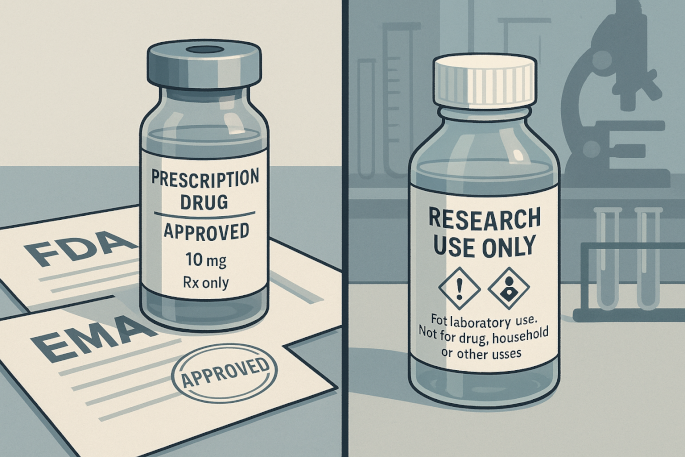
Understanding the regulatory status of Cartalax begins with the distinction between a substance and a medicine.
The Requirement for Regulatory Approval
For any substance to be legally marketed, sold, and administered as a drug for a human ailment in the USA or EU, it must secure official authorization.
- USA: New Drug Application (NDA): The FDA requires the submission of a comprehensive New Drug Application (NDA). It involves a culmination of years of preclinical and clinical data proving the drug is both safe and effective for its intended use [4].
- EU: Market Authorization (MA) (EMA): The European Medicines Agency (EMA) requires a similar Market Authorization (MA) via centralized or national procedures [7]. It is based on the same standard of proving robust quality, safety, and efficacy [5].
Cartalax has completed neither of these steps. It has not filed a publicly recognized Investigational New Drug (IND) application to begin human trials. It also has yet to receive NDA approval. Therefore, it is a misbranded drug if marketed for human use. Thus, its commercialization as a medicine is illegal [4].
The Classification of “Research Use Only” (RUO)
In commerce, Cartalax is typically sold as an RUO chemical. This classification is intended to shield suppliers from legal responsibility.
- Definition: RUO chemicals are not intended for human or animal consumption, application, or therapeutic use. They are materials legally sold exclusively for non-clinical scientific experimentation [4].
- The Liability Disclaimer: The seller of an RUO chemical must include explicit disclaimers stating that the product is “not for human use” or “for laboratory use only.” Any physician or individual acquiring Cartalax for patient care and bypassing this disclaimer is assuming full legal and ethical liability for dispensing an unapproved substance, even when the discussion is framed as conservative experimentation like Cartalax microdosing.
- The “Black Market” and Misbranding: When Cartalax is knowingly purchased and administered to a patient for OA, it instantly becomes a misbranded drug under the Federal Food, Drug, and Cosmetic (FD&C) Act. This is because it lacks the labeling, approval, and proof of safety and efficacy required for its therapeutic claims [4].
The Quality Crisis: The Failure of GMP and CMC
The most significant immediate regulatory hurdle for Cartalax, shared by all unapproved peptides, is the absolute lack of guaranteed quality, purity, and manufacturing consistency. This is the failure of the Chemistry, Manufacturing, and Controls (CMC) section.
Good Manufacturing Practice (GMP) Requirement
GMP compliance is the set of regulations that ensure that drugs are consistently produced and controlled according to quality standards [2, 5].
A peptide synthesized in a regulated GMP facility ensures that Batch A is chemically identical, in purity and potency, to Batch Z [5]. Unregulated manufacturers cannot guarantee this. For the patient, this means they have no certainty regarding the dose or chemical nature of the product they receive.
The chemical synthesis of peptides is complex and frequently results in a host of impurities that must be meticulously identified and quantified [5]:
- Truncated Sequences: Peptides that stopped growing prematurely
- Racemization: The presence of the wrong mirror-image form of an amino acid (D-amino acids instead of L-amino acids). These can render the entire peptide inactive or toxic.
- Aggregated Forms: Clumping of peptide molecules. This can trigger adverse immune reactions [5].
Approved peptides often require purities of 98% or higher—use the Cartalax purity guide to understand testing standards and vendor red flags. Unregulated Cartalax samples frequently fail to meet this threshold. This exposes patients to unknown toxicity and reduces the therapeutic effect.
Analytical and Toxicological Characterization
The CMC section of an NDA requires the sponsor to define the drug’s precise chemical formula. They must also provide complete toxicology on the drug product, including any impurities.
- Safety of Impurities: An approved drug sponsor must test and prove that all identified impurities, even at trace levels, are non-toxic [5]. Unregulated Cartalax is sold with no such characterization or guarantee.
- The Purity-Safety Loop: The FDA mandates GMP and CMC because quality is inextricable from safety. An impure product is, by definition, an unsafe product [5].
The Clinical Barrier: Efficacy and Long-Term Safety
Beyond quality, the core regulatory failure lies in the absence of human data proving efficacy and safety.
The Missing Efficacy Data (DMOAD Proof)
The claimed therapeutic goal of Cartalax is to act as a DMOAD, a drug that fundamentally alters the disease progression of OA [1], which is why the proposed indication context matters—see Cartalax for osteoarthritis and knee cartilage for how OA claims are typically framed. Proving this requires evidence far more robust than simple symptomatic relief.
- Structural Endpoints: Future regulated trials of Cartalax must use advanced imaging techniques (qMRI, T2 Mapping, dGEMRIC) over multiple years. These trials help demonstrate that the epigenetic reset results in the maintenance or improvement of cartilage quality and proteoglycan content [4].
- Biomarker Validation: Trials must validate the mechanism by showing a sustained reduction in specific biomarkers of cartilage catabolism (e.g., CTX-II) [3, 4].
- Absence of Data: Because no such trials have been publicly completed or registered on clinicaltrials.gov for Cartalax, the efficacy claim is unsupported by regulatory evidence.
The Safety Vacuum (Long-Term Toxicology)
The most ethically concerning absence of data relates to long-term human safety.
- The Epigenetic Risk: Cartalax is hypothesized to work by altering gene expression via chromatin modulation [1]. Any compound that influences the epigenetic machinery carries a theoretical, but serious, risk of unintended, off-target genetic effects.
- Oncogenesis Concern: The greatest theoretical risk is the potential for long-term administration to inadvertently influence oncogenes or tumor suppressor genes [1, 4]. Proving that a gene-modulating peptide is safe over the patient’s lifetime requires decades of controlled monitoring. This is currently non-existent for Cartalax, which is why practical expectations often get reduced to short-horizon timelines and markers rather than real long-term safety evidence.
The Mechanisms of Prohibition: Compounding Ban (USA)
The FDA has targeted the most common pathway for unapproved peptides to enter the patient market: the compounding pharmacy. This is the key reason for the major decline in patient access since the early 2020s.
The FD&C Act and Compounding Loopholes
Historically, compounding pharmacies were allowed to mix customized medications for specific patients based on a doctor’s prescription, provided they used approved ingredients. This was regulated under two sections of the FD&C Act [4].
- Section 503A (Traditional Compounding): For local, small-scale compounding of drugs by licensed pharmacists. Generally from approved bulk substances [4]
- Section 503B (Outsourcing Facilities): For large-scale, mass compounding by specialized facilities. Subject to stricter GMP-like requirements [4]
The FDA’s Response: The Bulk Drug Substance List
To halt the spread of unapproved peptides, the FDA utilized its authority to define which Bulk Drug Substances could be used in compounding [4].
Interested parties must submit a formal nomination, including clinical and safety data, for a substance to be included on the Positive List, meaning it can be compounded [4].
The FDA has classified most unapproved peptides, including those analogous to Cartalax, as Category 2 substances [4], which is one reason people confuse legality with safety—review Cartalax side effects and potential complications for risk context. This category is reserved for substances for which there is insufficient human clinical data to support safety, or for which safety concerns have been identified [4].
Because peptides like Cartalax have not secured a place on the Positive List and are flagged under Category 2, the FDA has effectively prohibited their use in both 503A and 503B compounding. This legally cuts off their supply to clinics and patients [4].
The Future Legal Pathway: The $1 Billion Investment
For Cartalax to transition from a research chemical to a legal medicine, it must successfully navigate the entire regulatory process. This represents a massive financial and scientific undertaking.
The Investigational New Drug (IND) Application
The first step toward legalization is filing the IND with the FDA [4]. This allows the sponsor to ship the drug across state lines and administer it to humans legally for testing—and it also clarifies why unregulated “cycle” advice online often mimics structured concepts like Cartalax loading phases without any approved framework.
The IND must include:
- Preclinical Animal Data: Toxicology and pharmacology studies in animals (e.g., rats, dogs) to determine a safe starting dose for humans [4]
- Initial CMC Data: Proof of high-quality synthesis and purity for the drug product used in the initial human trials [5]
The Clinical Trial Phases
The sponsor must then spend years and potentially hundreds of millions of dollars executing the required phases. All must be compliant with Good Clinical Practice (GCP) standards [4].
- Phase I: Small human trials focused on safety and pharmacokinetics (how the body absorbs, distributes, and excretes Cartalax) [4]
- Phase II: Larger trials focused on determining the optimal dosing and establishing preliminary evidence of efficacy in OA patients [4]
- Phase III: Large, pivotal, multi-center trials, often involving thousands of patients). Focused on definitive proof of safety and DMOAD efficacy against a placebo or standard of care [4]
Final NDA Submission
Only after successful completion of Phase III can the final NDA be submitted for FDA review. The entire process, from IND to NDA approval, typically costs over one billion dollars [6]. It also takes 10 to 15 years to complete.
Conclusion: Prohibition Until Proven
The legal status of Cartalax (Ala-Glu-Asp) is unambiguous. It is not legal for therapeutic use in the USA or the EU. This prohibition is the necessary regulatory shield protecting the public from the dangers of unproven efficacy, uncharacterized long-term safety, and, most immediately, the unacceptable risks associated with non-GMP manufacturing and purity failures.
The systematic closure of the compounding pharmacy loophole reinforces that the only route for Cartalax to enter the medical sphere is via the formal, regulated process of an Investigational New Drug (IND) and eventual New Drug Application (NDA). Until a pharmaceutical sponsor makes that immense commitment, Cartalax remains strictly a research curiosity.
Citations
[1] Chondrocyte Homeostasis and Differentiation: Transcriptional Control and Signaling in Healthy and Osteoarthritic Conditions – MDPI. URL: https://www.mdpi.com/2075-1729/13/7/1460
[2] Epigenetic Regulation of Chondrocytes and Subchondral Bone in Osteoarthritis – MDPI. URL: https://www.mdpi.com/2075-1729/12/4/582
[3] NF-kappaB Signaling Pathways in Osteoarthritic Cartilage Destruction – PMC – NIH. URL: https://pmc.ncbi.nlm.nih.gov/articles/PMC6678954/
[4] Regulatory Guidelines for the Analysis of Therapeutic Peptides and Proteins – PMC – NIH. URL: https://pmc.ncbi.nlm.nih.gov/articles/PMC11806371/
[5] Therapeutic Peptides: Recent Advances in Discovery, Synthesis, and Clinical Translation – PMC – NIH. URL: https://pmc.ncbi.nlm.nih.gov/articles/PMC12154100/
[6] Federal Medication Development Regulation – PMC – NIH. URL: https://www.ncbi.nlm.nih.gov/books/NBK574558/
[7] Regulating medicines in Europe: the European Medicines Agency, marketing authorisation, transparency and pharmacovigilance Overview- PMC – NIH. URL: https://pmc.ncbi.nlm.nih.gov/articles/PMC4954442/