
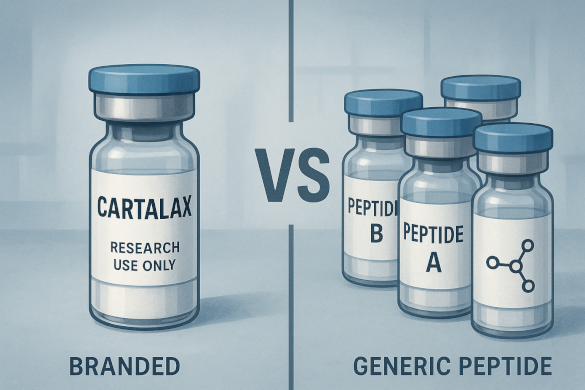
The burgeoning field of peptide therapeutics is defined by a dichotomy. This is the use of generic, broad-spectrum peptides designed for systemic functions, versus highly specialized, tissue-specific bioregulators like Cartalax (Ala-Glu-Asp) [1, 2].
While generic peptides may offer wide-ranging healing properties, the growing body of research supports the assertion that for complex, localized conditions such as joint degeneration and age-related tissue decline, peptides with precise tissue specificity and highly focused mechanisms of action are scientifically and therapeutically superior [1, 3]. This distinction underpins the research focus behind cartalax peptide as a tissue-specific bioregulator.
Cartalax is an ultrashort tripeptide that belongs to the family of synthetic bioregulators. Its molecular structure and gene-regulatory role are explained in detail in what Cartalax peptide is.
It is designed to interact directly with genetic mechanisms in a targeted tissue, in its case, the chondrocytes responsible for maintaining healthy cartilage [1, 4]. Understanding why this specificity matters, from the molecular level to translational research, is crucial for researchers selecting the appropriate agent for studies in regenerative medicine, anti-aging, and joint health [4].
This article explores the fundamental differences between Cartalax and generic peptides. These differences translate into the practical outcomes summarized in Cartalax peptide benefits. It helps demonstrate why focused tissue targeting is a critical differentiator for scientific rigor and therapeutic potential, particularly when aiming for sustained, high-fidelity biological outcomes over generalized healing responses.
Defining the Dichotomy: Mechanism and Structure
The distinction between Cartalax and generic, systemic peptides begins with their structure. They also differ based on their intended biological role and the resultant differences in their pharmacokinetics. Pharmacokinetics refers to how the body handles them.
Ultrashort vs. Long-Chain Peptides: Permeability and Targeting
Generic or systemic peptides, often studied for broad effects (e.g., those targeting widespread growth factor receptors), are typically longer-chain peptides. They sometimes exceed 15 amino acids [3].
Their size and structure often dictate an extracellular mechanism of action. They involve binding to cell surface receptors to trigger a cascade of secondary messenger signaling pathways [3].
Cartalax is an ultrashort tripeptide (Ala-Glu-Asp) that represents a distinct class: the ultrashort bioregulators [1]. Its brevity places it among a select group of molecules capable of significant membrane permeability [2, 4].
- Cellular Penetration: Ultrashort peptides possess physicochemical properties (small size, optimal charge, and hydropathy) that facilitate their transport across cell membranes, often mediated by specialized carriers like the Proton-coupled Oligopeptide Transporters (POT family) or other specific amino acid/oligopeptide membrane channels [1]. This crucial difference enables Cartalax to bypass traditional surface signaling and pursue an intracellular or epigenetic mechanism of action [1].
- Impact of Size: Longer, generic peptides face significant challenges in penetrating the cell membrane intact. They often rely on endocytosis or require cleavage into smaller active fragments. These can be inefficient and unpredictable [3]. Cartalax, by contrast, is engineered to utilize existing nutrient transport systems, ensuring a direct route to its intracellular target [1]. This fundamental difference in transport mechanism is key to its tissue specificity.
Genetic Regulation vs. Receptor Stimulation
The most significant functional difference lies in the ultimate target mechanism within the cell. The goal gets shifted from widespread signaling to precise cellular correction [1, 2].
Tissue-Specific Epigenetic Regulation (Cartalax)
Cartalax is hypothesized to function as a gene bioregulator. Studies suggest that ultrashort peptides can interact with genetic machinery (DNA regions, transcription factors, or histone proteins) within the cell nucleus or cytoplasm [1, 2].
For Cartalax, the target is the chondrocyte’s genome. This influences the expression of genes responsible for cartilage matrix homeostasis [1]. The peptide aims for cellular normalization by:
- Cartilage Structure Genes: Upregulating the synthesis of key components like Collagen Type II and aggrecan [1]
- Catabolic Enzyme Modulation: Potentially downregulating the expression of matrix-degrading enzymes such as Matrix Metalloproteinases (MMPs). These are overexpressed in osteoarthritis and joint degeneration [3].
- Anti-Senescence: Supporting the long-term survival and function of chondrocytes by potentially reducing markers of cellular aging within the joint tissue [1].
Generic Receptor Activation (Broad-Spectrum Peptides)
Many generic peptides act by stimulating widespread receptors. This mechanism is inherently systemic and pleiotropic, meaning it affects many cell types [4].
While effective for promoting general wound healing or angiogenesis, it lacks the precise targeting required to correct localized, pathological gene expression specifically within the chondrocyte population [3]. The response is often a generalized, non-tailored signal.
The Imperative of Tissue Specificity in Joint Health
The unique anatomical and physiological environment of articular cartilage necessitates an agent with focused tissue-targeting capabilities. Generic systemic peptides cannot reliably achieve this.
Overcoming the Avascular Barrier
Articular cartilage is a challenging and relatively isolated environment for systemic drug delivery. It presents a significant hurdle that generic systemic agents struggle to clear [4].
- Avascularity and Diffusion: Cartilage lacks blood vessels and nerves [4]. Due to this, it relies entirely on slow diffusion from the surrounding synovial fluid and the underlying subchondral bone for nutrient, oxygen, and drug delivery. This makes it an area of extremely poor drug penetration.
- Systemic Dilution and Degradation: A generic peptide, administered systemically (e.g., subcutaneously or intravenously), is immediately subject to rapid systemic degradation by blood, liver, and kidney proteases, as well as massive dilution across the entire body’s fluid volume [3]. By the time the active generic peptide reaches the synovial fluid, the concentration that eventually diffuses into the depth of the avascular cartilage is often negligible or insufficient to trigger the desired localized effect [4].
- Tissue Specificity Solution: Cartalax’s hypothesized potency at extremely low concentrations and its utilization of selective membrane transporters [1] are key design features that mitigate this challenge. The mechanism is designed to be highly effective at the low micromolar or even nanomolar concentrations that may be achieved within the joint matrix. This ensures that the limited supply of the agent is efficiently utilized by the target cell. This efficiency is critical for overcoming the delivery constraints of avascular tissue. This is also why Cartalax peptide dosage precision is essential in research protocols.
Minimizing Off-Target Effects and Pleiotropy
A lack of specificity in peptide therapeutics carries inherent biological risks. This is particularly true in the delicate metabolic and structural balance of the joint [3].
- Generic Activation Risk: A generic peptide that upregulates a widespread healing or proliferative pathway (e.g., general fibroblast proliferation or osteoblast activity) will activate these pathways across all tissues where the target receptor is present [4]. In the joint context, this could promote undesirable, maladaptive remodeling outcomes, such as excessive subchondral bone remodeling, osteophyte formation (bony spurs), or non-specific synovial fibrosis [4]. These effects are often detrimental to joint function.
- Cartalax Selectivity: By targeting the core functional unit, the chondrocyte, and influencing its specific transcription patterns (e.g., supporting Collagen Type II synthesis), Cartalax aims for a normalization of cellular activity tailored precisely to the tissue’s homeostatic needs [1, 3]. This highly targeted approach aligns with modern pharmaceutical goals of high selectivity to reduce the likelihood of systemic toxicity or local adverse effects like tumor promotion [3]. This localized action improves the therapeutic index.
Pharmacokinetic and Metabolic Advantages of Ultrashort Peptides
The difference in size between Cartalax and generic, longer peptides creates distinct advantages in terms of the body’s metabolism and the peptide’s overall safety profile. Maintaining these advantages depends on proper handling outlined in Cartalax storage and shelf life guidance. This particularly concerns its ultimate breakdown and clearance.
Predictable Metabolism and Low Immunogenicity
Longer peptides often require complex degradation pathways. They can potentially trigger an immune response, challenging their chronic therapeutic use [3].
- Metabolic Simplicity: Cartalax, a tripeptide composed of Alanine, Glutamic Acid, and Aspartic Acid, breaks down into naturally occurring, essential metabolic building blocks [4]. This makes the metabolic fate of Cartalax highly predictable. Its degradation products are easily incorporated into the body’s normal amino acid pool without risk of accumulating toxic or foreign metabolites [3].
- Low Immunogenicity: The use of only naturally occurring L-amino acids and the ultrashort sequence length minimizes the probability of the molecule being recognized as foreign by the immune system [3]. This contrasts with large protein biopharmaceuticals or longer synthetic peptides, which may have higher potential for triggering an immune response [3]. The low risk of immunogenicity is a critical factor in the safety profile of agents intended for chronic conditions like joint degeneration, where repeated dosing is necessary. Safety considerations are key; review potential issues in Cartalax Side Effects: Potential Complications Of This Peptide.
Enhanced Formulation Flexibility
The physicochemical properties of ultrashort peptides offer superior flexibility for creating effective drug delivery systems. This is a crucial element for future translational research [1, 6].
- High Aqueous Solubility: Cartalax is generally highly soluble in aqueous solutions due to its small size and polar residues. This simplifies reconstitution protocols for researchers. For proper preparation, follow Cartalax Peptide Reconstitution Guide: Step-by-Step For Lab Use. It allows for the creation of high-concentration stock solutions, which is often necessary when designing delivery vehicles [6].
- Biomaterial Integration: The simple structure of Cartalax makes it an ideal candidate for integration into advanced delivery systems. This includes drug-eluting hydrogels or tissue scaffolds [4]. Researchers can use the Cartalax sequence to functionalize scaffolds by covalently binding the peptide to the material [4]. This creates a biomaterial that is not just a passive matrix but possesses an active, chondrogenic inductive quality. These help guide encapsulated stem cells or local fibroblasts toward the desired cartilage phenotype [4]. Maintaining integrity requires proper handling; see Cartalax Storage & Shelf Life: Keeping Your Peptides Potent In 2026. This level of precise, localized delivery and signal control is impractical with larger, less mobile peptides.
Research Validation and Translational Rationale
The specialized nature of Cartalax influences everything. This includes the design of preclinical models and the strict standards required for progression to human clinical trials, where specificity is directly linked to regulatory success [5].
High Fidelity in Preclinical Modeling
For researchers modeling age-related joint decline, high-fidelity data that minimizes confounding variables is paramount.
- Attributing Effect: When a researcher observes a positive change in cartilage structural components (e.g., increased Collagen Type II synthesis) or a reduction in cellular senescence markers in a cell culture model using Cartalax, they can confidently attribute that effect to a mechanism specifically mediated by the Ala-Glu-Asp sequence acting on chondrocyte transcription [1, 4].
- Generic Ambiguity: If a generic, systemic peptide is used, any observed improvement in cartilage health could be a non-specific, secondary effect. This is perhaps due to the reduction in systemic inflammation or improved subchondral bone activity, rather than a direct regenerative effect on the chondrocyte itself [4]. This ambiguity significantly weakens the scientific conclusion and makes it difficult to pinpoint the precise molecular targets. Avoid common errors by reviewing Beginner Mistakes With Cartalax: Common Pitfalls In Research Protocols. Thus, it can complicate the path to clinical validation [5].
Regulatory and Clinical Trials Focus
Regulatory platforms like ClinicalTrials.gov necessitate clear, validated mechanisms of action and highly specific targets for investigational drugs [5].
- Mechanism Clarity: Cartalax’s sharp focus on chondrocyte gene regulation provides a clean, testable hypothesis for clinical trial design [1, 5]. Future trials would focus on biomarkers directly related to cartilage health (e.g., changes in synovial fluid proteomics or magnetic resonance imaging (MRI) analysis of cartilage thickness) to prove efficacy and monitor safety [5]. The precision of the mechanism simplifies the primary endpoint selection.
- Generic Challenges: Longer, generic peptides often face substantial challenges in defining a single, clear primary mechanism of action. This is due to their broad receptor binding profiles [3]. Proving bioequivalence, safety, and efficacy requires greater resources and faces more intense regulatory scrutiny when the target tissue and mechanism are not sharply defined [3]. For sourcing compliant, high-quality samples, see Cartalax for Sale: Reputable Places To Buy This Peptide. For example, a growth factor-mimicking peptide might promote tissue proliferation. However, regulators must ensure it does not promote pathological proliferation (cancer) elsewhere in the body. This is a risk significantly mitigated by the high tissue specificity of Cartalax [3].
The Goal of Disease Modification
Ultimately, the choice between Cartalax and a generic peptide reflects a fundamental difference in research goals. This distinction is central to Cartalax peptide for joint recovery research. Generic peptides are often aimed at symptom relief (e.g., reducing inflammation) or general healing promotion. Cartalax, by contrast, is aimed at disease modification [4].
- Chondroprotection: By supporting the survival and function of existing chondrocytes, Cartalax attempts to arrest or reverse the underlying cellular pathology of joint degeneration [1]. This is a higher-value, long-term goal compared to a temporary, systemic healing signal. The specificity of Cartalax is the key enabling factor for this ambitious goal of regenerating and maintaining a healthy, functional cartilage matrix. The ability to specifically target the cellular machinery responsible for degeneration is the future of regenerative medicine.
In conclusion, while generic peptides offer utility in broad healing contexts, the research on Cartalax clearly demonstrates the indispensable value of tissue-specific targeting for complex, localized conditions like joint degeneration. The ability of the Ala-Glu-Asp sequence to penetrate cells and directly regulate the gene expression of chondrocytes offers a mechanism of action with superior fidelity and lower systemic risk.
It also a higher potential for standardized, reproducible outcomes in the pursuit of genuine disease-modifying tissue regeneration.
For the detailed mechanisms, return to What Is Cartalax Peptide? Mechanisms & Research Breakdown.
For the comprehensive overview, see Cartalax Peptide: The Ultimate Guide For 2025.
Citations
[1] Transport of Biologically Active Ultrashort Peptides Using POT and LAT Carriers – PMC. https://pmc.ncbi.nlm.nih.gov/articles/PMC9323678/
[2] Neuroepigenetic Mechanisms of Action of Ultrashort Peptides in Alzheimer’s Disease – MDPI. https://www.mdpi.com/1422-0067/23/8/4259
[3] Exploring the Potential of Bioactive Peptides: From Natural Sources to Therapeutics – NIH. https://pmc.ncbi.nlm.nih.gov/articles/PMC10855437/
[4] The state of cartilage regeneration: current and future technologies – PMC. https://www.ncbi.nlm.nih.gov/pmc/articles/PMC4596193/
[5] The Current Status of Clinical Trials on Biologics for Cartilage Repair and Osteoarthritis Treatment: An Analysis of ClinicalTrials.gov Data – clinicaltrials.gov. https://pubmed.ncbi.nlm.nih.gov/35546280/
[6] Synthetic Peptide Purification via Solid-Phase Extraction with Gradient Elution: A Simple, Economical, Fast, and Efficient Methodology – PMC. https://pmc.ncbi.nlm.nih.gov/articles/PMC6479624/