
The use of investigational peptides, such as the ultrashort bioregulator Cartalax (Ala-Glu-Asp), in preclinical research demands a level of procedural rigor often underestimated by new researchers [1, 2]. These challenges are characteristic of cartalax peptide research in laboratory settings.
Cartalax is typically studied for its influence on chondrocyte gene expression. A detailed explanation of these mechanisms is outlined in what Cartalax peptide is. It’s also notable for its role in maintaining the extracellular matrix, key processes in regenerative medicine and aging research [3].
Because its hypothesized effects are subtle and depend on its precise molecular structure and concentration, even minor deviations in handling can lead to significant experimental variability, irreproducible results, and wasted resources [2, 6].
This comprehensive guide addresses the most common and critical beginner mistakes encountered when incorporating Cartalax into research protocols, spanning the entire lifecycle of the peptide, from initial receipt and reconstitution to dosing and long-term storage.
By understanding and proactively mitigating these pitfalls, researchers can maximize the potency of Cartalax and ensure the validity of their findings [7].
Beginner Mistakes in Initial Peptide Handling and Receipt
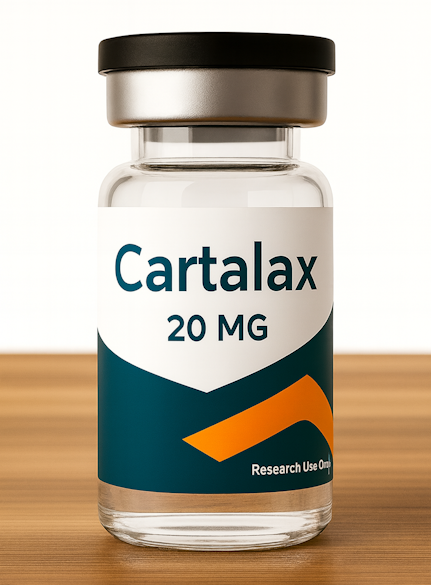
The earliest points of failure often occur before the peptide is even dissolved. To appreciate the value of avoiding these errors, review the potential outcomes in 5 Cartalax Peptide Benefits You Need To Know. This stems primarily from a misunderstanding of the stability of the lyophilized powder. Long-term stability considerations are covered in Cartalax storage and shelf life guidelines.
Mistake 1: Ignoring Temperature Equilibration (The Hygroscopicity Trap)
The most catastrophic initial error is failing to allow the lyophilized Cartalax vial to reach room temperature before opening it.
- The Pitfall: Cartalax, containing polar acidic residues (Glutamic Acid and Aspartic Acid), is highly hygroscopic [2, 7]. When a cold vial (from minus 20 degrees Celsius storage) is exposed to warmer laboratory air, ambient moisture immediately condenses onto the cold powder. This introduces water, triggering the rapid onset of chemical degradation, primarily hydrolysis [2, 6].
- The Consequence: The introduction of water initiates the breakdown of peptide bonds. It can also accelerate the formation of the inactive iso-aspartate analog from the Aspartic Acid residue. As a result, it immediately reduces the true potency of the stock before any experiment has begun [2].
- Correction: The sealed vial must be removed from the freezer and placed in a dry environment, preferably a desiccator or a secondary sealed container. It must also be allowed to warm completely to room temperature (20 to 25 degrees Celsius) for a minimum of 30 to 60 minutes before the seal is broken or the septum is pierced [2, 7].
Mistake 2: Storing the Lyophilized Powder Incorrectly
Assuming that refrigeration is sufficient for long-term storage of the primary stock.
- The Pitfall: Storing the primary stock of lyophilized Cartalax powder at a standard refrigerator temperature of 4 degrees Celsius for more than a few months. For reliable sourcing to start with high-quality stock, see Cartalax for Sale: Reputable Places To Buy This Peptide. While this temperature is cold, it is insufficient to fully halt the molecular movement necessary to ensure maximum shelf life [6].
- The Consequence: Degradation reactions, including hydrolysis and deamidation, occur significantly faster at 4 degrees Celsius than at sub-freezing temperatures [6]. For research projects spanning a year or more, this practice guarantees a gradual, measurable decline in peptide purity and potency over the study duration. In turn, this compromises the standardization of the administered dose [7].
- Correction: Primary stock vials of lyophilized Cartalax must be stored at minus 20 degrees Celsius or lower (minus 80 degrees Celsius is optimal for multi-year stability). This can help minimize molecular kinetics and maximize the preservation of its chemical integrity [6, 7].
Beginner Mistakes in Reconstitution and Concentration
Errors during the reconstitution phase are volumetric, chemical, and physical. Correct handling steps are detailed in the Cartalax peptide reconstitution guide. Each are capable of rendering the entire stock unusable or non-sterile.
Mistake 3: Inaccurate Volumetric Calculation and Solvent Choice
Failing to calculate the solvent volume precisely or choosing an inappropriate solvent.
- The Pitfall (Calculation): Using rounded numbers or failing to account for the exact mass of powder (M) as specified on the Certificate of Analysis (CoA) [7].
- The Consequence (Calculation): Leads to a final stock concentration that is either higher or lower than intended. Since Cartalax is typically used at low microgram per milliliter doses in cell culture or microgram per kilogram doses in vivo, small errors in stock concentration are magnified in the final administered dose. This makes strict adherence to Cartalax peptide dosage calculations essential. This can result in skewed dose-response curves [3].
- The Pitfall (Solvent): Using non-sterile distilled water or simple saline for reconstitution, especially if the stock is intended for long-term storage or in vivo use [7].
- The Consequence (Solvent): Standard, non-bacteriostatic water lacks the preservative necessary to inhibit microbial growth after the seal is broken. This results in microbial contamination [7].
- Correction: Always use the formula V equals M divided by C to calculate the exact volume. Reconstitute stock solutions with Bacteriostatic Water for Injection (BWFI). This solution contains a preservative (e.g., Benzyl Alcohol), to extend the sterile shelf life of the stock aliquot [7].
Mistake 4: Introducing Shear Stress During Dissolution
Reconstituting the lyophilized cake with excessive force or agitation.
- The Pitfall: Injecting the solvent forcefully directly onto the powder or shaking the vial vigorously (high-speed vortexing) to speed up dissolution [2].
- The Consequence: High mechanical force creates shear stress and introduces air bubbles into the solution. This results in the acceleration of oxidation [2, 6]. Although Cartalax is an ultrashort peptide, excessive mechanical stress can promote peptide aggregation or denaturation of any stabilizing excipients present, compromising solubility and biological activity [2].
- Correction: Always inject the solvent slowly down the side of the vial. Use only gentle swirling for initial dissolution. If necessary, a low-speed vortex or brief sonication in a water bath can be used to break up aggregates. However, aggressive agitation must be strictly avoided [2].
Mistake 5: Skipping Sterile Filtration
Assuming that sterile handling alone is sufficient to guarantee the solution is free of contaminants.
- The Pitfall: Failing to pass the reconstituted stock solution through a 0.2 micrometer syringe filter before aliquoting [7].
- The Consequence: Even with rigorous aseptic technique, handling can introduce minute particulate matter or airborne microbial contaminants [7]. In cell culture or in vivo models, these contaminants can trigger immune responses or skew viability assays. Potential complications from such issues are discussed in Cartalax Side Effects: Potential Complications Of This Peptide. It can also lead to rapid peptide degradation by microbial proteases [2].
- Correction: After full dissolution, sterile filtration is mandatory for all Cartalax stock solutions intended for cell culture or animal injection. This step ensures that the stock solution is free of both insoluble particulates and microbial load [2, 7].
Beginner Mistakes in Storage and Long-Term Potency
These errors are related to maintaining the stability of the aqueous solution over the days, weeks, and months required for a typical study.
Mistake 6: Failing to Aliquot the Stock Solution
Storing the entire reconstituted volume in a single vial for long-term use.
- The Pitfall: Placing the entire reconstituted stock vial (e.g., 5 milliliters) directly into the minus 20 degrees Celsius freezer, with the intent to thaw and refreeze it multiple times throughout the study [6, 7].
- The Consequence: Repeated freeze-thaw cycles are the single greatest cause of peptide degradation in aqueous solution [6, 7]. Each cycle exposes the solution to fluctuating temperatures. This process can promote chemical degradation (hydrolysis, deamidation) and physical aggregation [2]. It quickly reduces the potency of the entire stock. This means the dose administered in week one is chemically different and more potent than the dose administered in week eight [6]. Ultimately, it destroys the standardization necessary for meaningful results.
- Correction: The reconstituted, filtered stock solution must be immediately divided into small, single-use aliquots (e.g., 500 microliters each) [7]. Each aliquot should be thawed only once just before use. Additionally, any unused portion should be discarded.
Mistake 7: Mismanaging Working Dilutions
Preparing a low-concentration working solution days in advance of the experiment.
- The Pitfall (Time): Preparing the final working concentration (e.g., the 1 microgram per milliliter dose for cell culture) and storing it in the refrigerator for future use [6, 7].
- The Consequence (Time): The chemical stability of Cartalax at its final, highly dilute working concentration is extremely poor, even at 4 degrees Celsius [6]. Furthermore, working dilutions often use non-bacteriostatic buffers, like cell culture medium. These can rapidly promote microbial growth and protease-mediated degradation [2].
- The Pitfall (Adsorption): Using dilute working solutions in plasticware without considering peptide adsorption [4].
- The Consequence (Adsorption): At low concentrations, the Cartalax molecules can physically bind to the surface of the plastic tubes or plates [4]. This reduces the actual amount of active peptide in the liquid phase available to the cells. This causes the dose to be effectively zero, resulting in null experimental results [4].
- Correction: Working dilutions must be prepared fresh daily and used immediately. For highly dilute solutions, consider adding a low concentration of a non-ionic surfactant (e.g., Tween 80 at 0.01 percent) to the final diluent to block adsorption, if compatible with the assay [2].
Mistakes in Dosing and Experimental Protocol Design
These pitfalls relate to how the chemical characteristics of the peptide are incorporated into the actual biological protocol.
Mistake 8: Neglecting the Role of Peptide Transporters
Treating Cartalax as a standard receptor-binding protein, ignoring its mechanism of action.
- The Pitfall: Designing cell culture experiments (e.g., in chondrocytes or fibroblasts) that assume Cartalax works by binding to a surface receptor, like a growth factor [1].
- The Consequence: Research suggests that ultrashort peptides like Cartalax exert their effects through intracellular mechanisms. Thus, they require transport into the cytoplasm and potentially the nucleus [1]. This transport is hypothesized to be mediated by specific carrier systems, such as the Proton-coupled Oligopeptide Transporters (POT family) or the L-type Amino Acid Transporters (LAT1) [1]. If the experimental conditions (e.g., buffer composition, pH, or the presence of competing amino acids) inhibit these specific transporters, the peptide will not reach its gene-regulatory targets [1]. For why specificity in formulation matters, compare in Cartalax vs Generic Peptides: Why Tissue-Specific Matters.
- Correction: Protocols must be designed to support transporter function. For example, maintaining the correct pH gradient is critical for POT transporters [1]. Researchers should consult literature on specific peptide transporters when optimizing media and buffer compositions.
Mistake 9: Failing to Account for Catabolic Enzymes
Underestimating the physiological challenge faced by the peptide in vivo or in complex culture systems.
- The Pitfall: Assuming that the administered dose maintains 100 percent integrity in the bloodstream or within the joint space [3].
- The Consequence: In in vivo studies, Cartalax will be immediately exposed to peptidases and proteases present in the blood, liver, and synovial fluid [3]. Similarly, complex cell models or microphysiological systems (e.g., organ-on-a-chip models) [4] can contain catabolic enzymes that rapidly degrade the peptide. This, then, reduces its effective half-life and potency [3, 4].
- Correction: When designing in vivo dosing regimens, researchers must utilize pharmacokinetic studies or in vitro stability assays to estimate the effective half-life of Cartalax [3]. The administered dose must be higher than the target dose to account for systemic degradation. Or, protocols must be adjusted for more frequent dosing [3].
Mistake 10: Inconsistent Quality Control and Documentation
Skipping checks on the peptide stock over the study period.
- The Pitfall: Relying solely on the initial CoA provided by the supplier and assuming the peptide potency remains constant over two years of use [6].
- The Consequence: As shown in Mistake 6, potency inevitably degrades over time [6]. Without periodic quality control checks (e.g., High Performance Liquid Chromatography or Mass Spectrometry) on archived aliquots, researchers cannot differentiate between a genuine lack of biological effect and a failure caused by using a severely degraded, low-potency substance [2, 6].
- Correction: Establish a Quality Control (QC) schedule to periodically re-verify the purity of frozen aliquots. Every aliquot should be labeled with the date of reconstitution and the date of the last successful QC check. Establishing this can ensure complete traceability and scientific rigor [7].
Summary of Key Pitfalls and Best Practices
Avoiding these common pitfalls is paramount to the integrity of any research utilizing Cartalax. Success depends not on the peptide’s efficacy alone. It also depends on the meticulous control of environmental factors, chemical degradation pathways, and the logistical maintenance of a standardized, potent stock solution across the entire experimental timeline [5, 7].
| Common Pitfall | Consequence | Best Practice for Cartalax |
|---|---|---|
| Hygroscopicity Trap | Rapid hydrolysis and degradation upon opening the cold vial [2, 6] | Always equilibrate the sealed vial to room temperature (30-60 mins) before opening [7]. |
| Shear Stress | Peptide aggregation and oxidation during mixing [2, 6] | Use gentle swirling only; avoid aggressive vortexing [7]. |
| Incomplete Filtration | Microbial contamination and protease-mediated degradation [2] | Mandatory 0.2 µm sterile filtration after reconstitution [7] |
| Freeze-Thaw Cycles | Rapid loss of potency and physical aggregation [6, 7] | Immediate, single-use aliquoting of stock solution. Thaw only once [7]. |
| Adsorption | Loss of active dose to plastic walls at low concentrations [4] | Prepare working dilutions fresh daily. Consider using low-binding vials or surfactants [2, 4]. |
For the full overview, see Cartalax Peptide: The Ultimate Guide For 2025.
Citations
[1] Transport of Biologically Active Ultrashort Peptides Using POT and LAT Carriers – PMC. https://pmc.ncbi.nlm.nih.gov/articles/PMC9323678/
[2] Instability Challenges and Stabilization Strategies of Pharmaceutical Proteins – PMC. https://pmc.ncbi.nlm.nih.gov/articles/PMC9699111/
[3] Chondrocyte Homeostasis and Differentiation: Transcriptional Control and Signaling in Healthy and Osteoarthritic Conditions – MDPI. https://www.mdpi.com/2075-1729/13/7/1460
[4] Using Microphysiological System for the Development of Treatments for Joint Inflammation and Associated Cartilage Loss—A Pilot Study – MDPI. https://www.mdpi.com/2218-273X/13/2/384
[5] The Current Status of Clinical Trials on Biologics for Cartilage Repair and Osteoarthritis Treatment: An Analysis of ClinicalTrials.gov Data – clinicaltrials.gov. https://pubmed.ncbi.nlm.nih.gov/35546280/
[6] The Detrimental Effects of Crystalline Excipients: How They Jeopardize the Long-Term Stability of Freeze-Dried Polypeptide Formulations – MDPI. https://www.mdpi.com/1999-4923/17/12/1543
[7] Reference Standards to Support Quality of Synthetic Peptide Therapeutics – NIH. https://pmc.ncbi.nlm.nih.gov/articles/PMC10338602/