
The longevity and integrity of laboratory-grade peptides are determined not by the passage of time alone. It’s also determined by a rigorous adherence to storage protocols that counter the four main threats to molecular structure. These include moisture, temperature fluctuations, chemical degradation, and microbial activity [1, 2].
Ultrashort peptide bioregulators like Cartalax (Ala-Glu-Asp) are used in sensitive biological research focused on aging and cartilage regeneration. These requirements are specific to cartalax peptide and other ultrashort bioregulatory compounds. Thus, optimal storage is critical to ensure the validity and reproducibility of long-term studies that may span years [3, 4].
Cartalax is an investigational substance. For a deeper explanation of its molecular role and research origins, see what Cartalax peptide is.
Unlike approved pharmaceuticals, its formalized, guaranteed shelf life may not be extensively documented in publicly available literature. Therefore, researchers must rely on established analytical chemistry and pharmaceutical science principles for handling and stability testing of synthesized peptides [1, 6].
This guide provides a comprehensive overview of the maximum potential shelf life and essential handling techniques required to keep both the lyophilized powder and the reconstituted solution of Cartalax fully potent throughout its research lifecycle and well into 2026.
Lyophilized Cartalax: Principles of Powder Stability
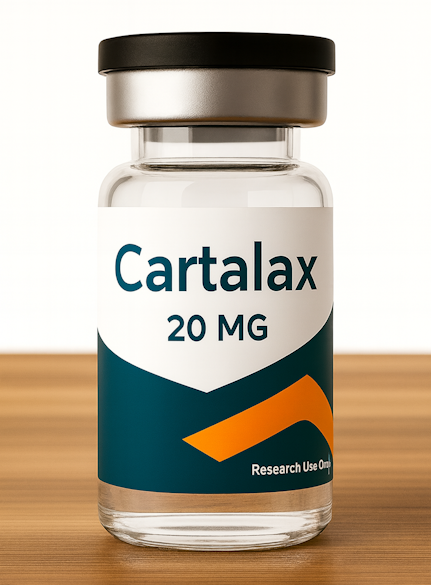
Cartalax is supplied in a lyophilized, or freeze-dried, powder form. This process involves freezing the peptide solution and then reducing the surrounding pressure. This allows the frozen water to sublime directly from the solid phase to the gas phase [6].
This essential process removes nearly all water content. As a result, it helps minimize the primary pathway for chemical degradation: hydrolysis [1]. When properly stored, the lyophilized form offers the greatest stability and the longest potential shelf life, serving as the primary stock for multi-year projects [6]. To understand the research value preserved by proper storage, explore 5 Cartalax Peptide Benefits You Need To Know.
Thermodynamics of Long-Term Storage
The stability of a lyophilized peptide is governed by the principles of thermodynamics and kinetics [1]. At standard ambient temperatures, chemical reactions occur rapidly. The purpose of deep-freezing is to reduce the energy available for molecular movement.
Minimizing Molecular Mobility: By storing Cartalax at minus 20 degrees Celsius or lower, the glass transition temperature of the amorphous solid is respected [1]. Below this critical temperature, the molecular motion of the solid matrix effectively ceases.
This reduces the rate of chemical degradation, like deamidation or hydrolysis, by a factor of hundreds or thousands [1]. This kinetic stability ensures that the peptide’s primary structure remains unchanged over extended periods.
Optimal Storage Requirements and Shelf Life
The maximum shelf life for lyophilized Cartalax depends strictly on maintaining sub-freezing temperatures and controlling the atmosphere within the sealed vial [1, 6].
| Storage Temperature | Maximum Estimated Shelf Life | Stability Rationale and Best Practice |
|---|---|---|
| Minus 20 degrees Celsius | 3 to 5 years (Minimum) | Standard long-term storage for synthesized peptides. Significantly slows molecular mobility and chemical degradation rates [1] |
| Minus 80 degrees Celsius | 5 years or longer | Optimal for ultralong-term preservation. Essential for archival samples or projects spanning over five years. Ensures maximum kinetic stability [1] |
| 4 degrees Celsius (Refrigerated) | 1 to 2 years (Short-Term/Backup) | Acceptable for shorter-term projects; however, the risk of moisture absorption increases compared to frozen storage [1, 4]. |
Critical Moisture Control Protocols
The most common cause of degradation in the lyophilized state occurs not during long-term storage, but during the moment the researcher opens the vial [1]. Cartalax, containing the polar residues Glutamic Acid (Glu) and Aspartic Acid (Asp), is highly hygroscopic. This means it readily absorbs moisture from the surrounding air [2].
Temperature Equilibration is Mandatory: Never open the peptide vial immediately after removal from the freezer [1]. These precautions are part of the broader Cartalax peptide reconstitution guide used in laboratory workflows. This lapse causes ambient moisture to condense onto the cold powder. This then initiates immediate hydrolysis and potential aggregation [1].
Procedure: Remove the vial from the freezer and place it in a dry environment, preferably a desiccator or a secondary sealed container, like a Falcon tube. Allow it to warm completely to room temperature (20 to 25 degrees Celsius) for 30 to 60 minutes before proceeding with reconstitution [1, 4].
Minimizing Air Exposure: If aliquoting the powder, the procedure must be performed rapidly in a low-humidity environment. After removing the desired portion, the remaining vial must be tightly resealed to prevent further moisture contamination and immediately returned to the deep freezer [1].
Degradation Pathways and Excipient Stabilization
The Cartalax tripeptide sequence (Ala-Glu-Asp) is chemically vulnerable to specific degradation reactions. It must be proactively managed through solvent selection and formulation principles [3, 6].
Hydrolytic and Deamidation Risk (Aspartic Acid)
The instability of Cartalax is strongly linked to its Aspartic Acid (Asp) residue, a common degradation site in pharmaceutical peptides [3].
Hydrolysis and Iso-Aspartate Formation: Asp residues can undergo a dehydration reaction. This leads to a cyclic imide intermediate [3]. This intermediate can then be subsequently hydrolyzed to yield the original Asp form or the iso-aspartate analog [3].
The iso-aspartate analog is structurally altered. Thus, this can potentially render the peptide inactive or lead to altered binding kinetics, compromising the research data [3].
pH Mitigation and Excipients: This reaction is accelerated at extremes of pH [1]. Research in peptide stabilization often involves formulating the aqueous solution (or the lyophilization buffer) with excipients to buffer the pH to a stable range (typically between pH 5 and pH 7) and incorporating stabilizers like polyols or sugars (e.g., mannitol or trehalose) [1, 6].
These excipients replace the water and form an amorphous glass matrix around the peptide. In turn, it can significantly enhance stability in both the lyophilized and reconstituted states [6].
Physical Degradation: Aggregation, Adsorption, and Shearing
Physical degradation affects the delivery and structural integrity of the peptide, irrespective of its chemical sequence [1].
Aggregation: This involves the physical self-association of peptide molecules, often leading to precipitation, haziness, or reduced solubility [1, 6]. Factors promoting aggregation include high concentration, inappropriate solvents, and vigorous mechanical stress [1].
For Cartalax, high concentration in aqueous solution may increase the rate of molecular collisions. This can help promote aggregation over time.
Adsorption (Surface Loss): At low experimental concentrations, the small, polar Cartalax peptide can physically adsorb onto the walls of plastic or glass containers [4]. This dramatically lowers the true peptide concentration in the solution. As a result, this leads to inaccurate dosing and experimental failure [4].
Mitigation: Use high-quality, low-binding polypropylene vials. For highly diluted working solutions, the addition of a small percentage of a non-ionic surfactant (e.g., Tween 80 or Pluronic F-68) can be incorporated into the final diluent. This can prevent surface adsorption, provided the surfactant is compatible with the biological assay [1].
Shear Stress: During reconstitution, vigorous shaking or aggressive vortexing can induce shear stress. The latter is a physical force that can accelerate the unfolding or aggregation of molecules [6]. Degradation can lead to unexpected outcomes; review potential issues in Cartalax Side Effects: Potential Complications Of This Peptide. Although Cartalax is an ultrashort tripeptide, gentle swirling is always the recommended method to ensure molecular integrity [6].
Handling and Shelf Life of Reconstituted Solutions
The transition from a stable powder to an aqueous solution drastically reduces shelf life [1, 2]. Once reconstituted, the three major threats are hydrolysis, microbial growth, and freeze-thaw cycles [6].
Aliquoting: The Key to Extended Potency
Storage of the entire reconstituted stock solution in a single vial is the most common cause of premature degradation and loss of potency [1, 2]. The repetitive temperature cycling of thawing and refreezing is chemically destructive.
Principle of Aliquoting: Immediately after reconstitution and sterile filtration, the stock solution must be divided into small, single-use aliquots. These are the volumes necessary for one experimental run [1, 2].
Storage Temperature and Time: Store these aliquots at minus 20 degrees Celsius or lower. This practice ensures that the stability of the entire stock is maintained for the maximum possible duration.
Shelf Life and Temperature Guidelines for Solution
| Storage Temperature | Maximum Estimated Shelf Life | Degradation Risk and Handling Protocol |
|---|---|---|
| Minus 20 degrees Celsius | 3 to 6 months | Minimal degradation, but absolute avoidance of repeated freeze-thaw cycles is mandatory [1] |
| 4 degrees Celsius (Refrigerated) | 1 to 2 weeks (Maximum) | Acceptable only for very short-term projects. Chemical stability decreases rapidly. The risk of hydrolysis and microbial growth increases [1, 4]. |
| Room Temperature (20 degrees Celsius) | Hours (Must use immediately) | High risk of rapid chemical degradation and immediate bacterial growth. Must be used immediately following dilution [1, 2] |
The Threat of Microbial Degradation
Unlike the lyophilized powder, aqueous solutions are highly susceptible to bacterial and fungal contamination [2, 4]. These microbes produce highly active proteases, enzymes that specifically cleave peptide bonds. Common errors leading to such issues are covered in Beginner Mistakes With Cartalax: Common Pitfalls In Research Protocols. These can rapidly inactivate the Cartalax peptide [2].
Mitigation (BWFI and Filtration): The use of Bacteriostatic Water for Injection (BWFI), which contains the preservative Benzyl Alcohol, is strongly recommended for stock solutions [4]. Furthermore, performing sterile filtration of the stock solution through a 0.2 micrometer filter is necessary. This filter can help eliminate any potential microbial load introduced during handling [1].
Quality Control (QC) and Verification of Extended Shelf Life
For research integrity in studies spanning several years, the theoretical shelf life must be verified periodically using analytical chemistry methods [6]. Vendor testing and handling expectations are outlined in this Cartalax purity guide. This ensures that the data collected in 2026 is based on a potent substance chemically identical to the baseline material.
High Performance Liquid Chromatography (HPLC)
The gold standard for determining peptide purity, integrity, and concentration is Reverse-Phase High Performance Liquid Chromatography (RP-HPLC) [6].
Purity Verification: The HPLC method separates the Cartalax peptide from its degradation products (e.g., iso-aspartate, hydrolyzed fragments, aggregates) based on differences in their hydrophobicity [6]. A loss of purity over time indicates a reduction in potency.
Potency Quantification: By comparing the area under the curve of the main Cartalax peak in aged aliquots against a freshly prepared standard, researchers can quantify the retained potency of the peptide [6]. A drop below a predefined threshold (e.g., 90 percent purity) necessitates discarding the stock. For sourcing verified high-purity stocks, see Cartalax for Sale: Reputable Places To Buy This Peptide.
Mass Spectrometry (MS) and Structural Integrity
While HPLC verifies purity, Mass Spectrometry (MS) verifies the molecular weight and structural integrity of the peptide [6].
Molecular Weight Confirmation: Using techniques like Electrospray Ionization Mass Spectrometry (ESI-MS), researchers can confirm that the peptide still possesses the correct molecular mass (333 daltons for Cartalax) [6]. The appearance of new peaks corresponds to altered molecular weights due to hydrolysis or deamidation. This confirms a loss of structural integrity, even if the HPLC purity appears sufficient.
Implications for Research Integrity and Regulatory Context
The rigorous preservation of Cartalax potency is crucial. The peptide is central to research involving joint health, which often requires longitudinal studies [5].
Maintaining Biological Standardization
Cartalax is studied as a gene-regulatory agent that modulates pathways like SOX9 and RUNX2 to support chondrocyte viability and extracellular matrix homeostasis [3, 4]. These subtle, biological effects are highly sensitive to the exact concentration and chemical form of the peptide [3].
Dose Accuracy: Degradation means the actual dose administered to a cell culture or animal model is lower than the nominal dose calculated during the initial reconstitution. This is why Cartalax peptide dosage calculations must always assume properly stored material.
This inconsistency directly leads to non-reproducible or inaccurate efficacy data [5]. For why specificity and quality matter, compare in Cartalax vs Generic Peptides: Why Tissue-Specific Matters. By adhering to strict storage protocols and QC checkpoints, researchers ensure standardization throughout the entire project timeline.
Translational and Clinical Imperatives
The principles of stability management for Cartalax align with the strict requirements detailed on platforms like ClinicalTrials.gov, which govern the use of all Investigational New Drugs (INDs) [5].
Regulatory Compliance: Before Cartalax could ever be considered for a human therapeutic application, its formulated stability must be definitively proven under the proposed storage conditions [5]. The laboratory practices outlined in this guide are the preclinical precursors to these essential regulatory requirements. They ensure that all data generated today is robust enough to support future translational efforts.
By implementing these comprehensive handling, storage, and quality control protocols, researchers can confidently manage the shelf life of their Cartalax peptide stock. Thus, they can guarantee its potency and the scientific integrity of their findings well into 2026 and beyond.
Read our comprehensive guide to Cartalax to learn everything you need to know about this peptide.
For the core mechanisms and breakdown, return to What Is Cartalax Peptide? Mechanisms & Research Breakdown.
For the full overview, see Cartalax Peptide: The Ultimate Guide For 2025.
Citations
[1] Instability Challenges and Stabilization Strategies of Pharmaceutical Proteins – PMC. https://pmc.ncbi.nlm.nih.gov/articles/PMC9699111/
[2] Peptide Synthesis, Purification, and Characterization – PMC. https://pmc.ncbi.nlm.nih.gov/articles/PMC8348434/
[3] Chondrocyte Homeostasis and Differentiation: Transcriptional Control and Signaling in Healthy and Osteoarthritic Conditions – MDPI. https://www.mdpi.com/2075-1729/13/7/1460
[4] Recommendations for the generation, quantification, storage and handling of peptides used for mass spectrometry-based assays – NIH. https://pmc.ncbi.nlm.nih.gov/articles/PMC4830481/
[5] The Current Status of Clinical Trials on Biologics for Cartilage Repair and Osteoarthritis Treatment: An Analysis of ClinicalTrials.gov Data – clinicaltrials.gov. https://pubmed.ncbi.nlm.nih.gov/35546280/
[6] The Impact of Formulation and Freeze Drying on the Properties and Performance of Freeze-Dried Limosilactobacillus reuteri R2LC – MDPI. https://www.mdpi.com/2673-8007/3/4/92
[7] Designing Formulation Strategies for Enhanced Stability of Therapeutic Peptides in Aqueous Solutions: A Review – MDPI. https://pubmed.ncbi.nlm.nih.gov/36986796/