
The use of peptides like Cartalax (Ala-Glu-Asp), an ultrashort peptide bioregulator, in laboratory research requires meticulous handling. This is particularly true during the reconstitution process. Cartalax, typically supplied in a freeze-dried powder form, must be accurately dissolved in a suitable solvent under aseptic conditions. These handling requirements are specific to cartalax peptide and other ultrashort bioregulatory compounds. This helps ensures stability, potency, and the sterility required for sensitive biological assays and in vivo studies.
Cartalax is an investigational compound used in the context of regenerative medicine and aging research. For background on its molecular role and research origins, see what Cartalax peptide is. In turn, adhering to strict protocol is especially paramount for obtaining reliable and reproducible data [1, 4].
This guide provides a comprehensive, step-by-step procedure for the safe and precise reconstitution of freeze-dried Cartalax for laboratory purposes. It also details required materials, solvent selection, and the best practices for storage. This protocol is based on established scientific principles for handling chemically synthesized, short-chain peptides used in biological research [4, 6, 7].

Pre-Reconstitution Preparation and Materials
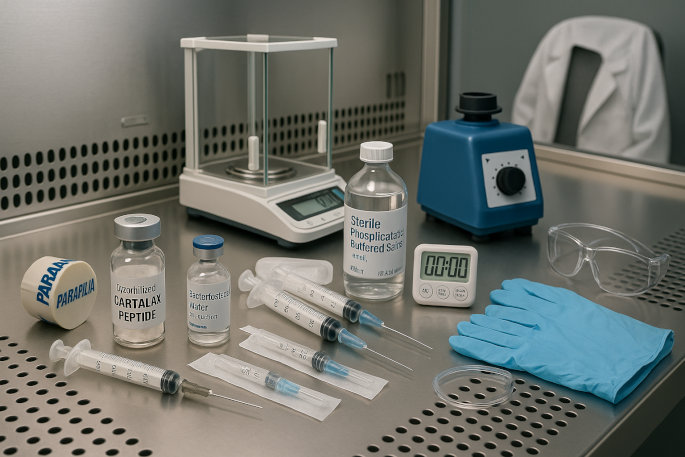
A successful reconstitution depends heavily on proper preparation. All materials should be sterile, the environment should be controlled, and the peptide powder should be properly handled. Precisely following these steps can prevent degradation or contamination. Maintaining peptide integrity also depends on sourcing that meets the standards outlined in this Cartalax purity guide.
Essential Materials and Equipment
The following materials are standard requirements for the aseptic reconstitution of peptides in a laboratory setting:
- Peptide Vial: Lyophilized Cartalax peptide, typically sealed in a sterile glass vial
- Reconstitution Solvent: The solvent chosen must match the planned downstream application and the peptide’s properties. For most biological research involving short peptides, Bacteriostatic Water for Injection (BWFI) or Sterile Phosphate Buffered Saline (PBS) is preferred [7].
- Sterile Syringes and Needles: Disposable, sterile syringes (e.g., 1 milliliter or 3 milliliter) and sterile needles (e.g., 23-gauge or 25-gauge) are required. These can help ensure precise solvent measurement and transfer. Safety considerations during use are important; review Cartalax Side Effects: Potential Complications Of This Peptide.
- Aseptic Workspace: A certified laminar flow hood is essential. During reconstitution, this can help maintain sterility and protect the sample from airborne contaminants.
- Personal Protective Equipment (PPE): Sterile gloves, lab coat, and eye protection.
- Laboratory Scale: An analytical balance capable of weighing milligrams with high accuracy may be needed if aliquoting the powder. Although, peptides are typically supplied in pre-weighed vials.
- Timer and Vortex Mixer: Used to ensure adequate dissolution time without aggressive agitation that could shear or denature the peptide
- Parafilm or equivalent seal: Used for sealing the vial septum after reconstitution. Can help maintain airtight integrity
Peptide Pre-Handling and Temperature Equilibration
Peptides, especially those containing residues like Glutamic Acid (Glu) and Aspartic Acid (Asp) as found in Cartalax, are prone to moisture absorption (deliquescence)1 [6]. Proper handling of the lyophilized powder is vital.
- Aliquoting (If Required): If the initial vial contains a large quantity of powder and will be used for multiple experiments over an extended period, the powder should be aliquoted. This must be performed quickly under dry conditions, preferably in a low-humidity environment. This can help minimize moisture uptake. Aliquoting helps avoid repeated freeze-thaw cycles and air exposure on the entire stock. For reliable sourcing, see Cartalax for Sale: Reputable Places To Buy This Peptide. These are major causes of peptide degradation [6].2
- Temperature Equilibration: Before opening the vial, it must be completely warmed to room temperature (20-25 degrees Celsius) [6]. Removing the vial directly from ultra-low storage (-20 degrees Celsius or -80 degrees Celsius) and opening it immediately will cause moisture in the surrounding air to condense rapidly onto the cold powder. This can significantly compromise its stability [6]. Allow 30–60 minutes for equilibration within the sealed secondary container.
- Wipe Down: Once equilibrated, carefully wipe the rubber stopper of the peptide vial and the solvent vial with a fresh 70 percent ethanol or isopropanol swab. Allow to fully air dry before piercing.
Selection of Reconstitution Solvent
The choice of solvent is dictated by the peptide’s sequence, its stability profile, and the requirements of the biological assay. For Cartalax (Ala-Glu-Asp), which is a short, polar, and slightly acidic tripeptide, aqueous solvents are typically used.
Rationale for Bacteriostatic Water (BWFI)
Bacteriostatic Water for Injection (BWFI) is the preferred solvent for preparing peptide stock solutions intended for storage or multiple uses over a short term, particularly for in vivo research [7].
- Composition: BWFI is Sterile Water for Injection that contains 0.9 percent Benzyl Alcohol (9 mg per mL) as a bacteriostatic preservative [7].5
- Extended Shelf Life: The Benzyl Alcohol prevents the growth of bacteria after the vial’s septum has been punctured [7]. This is crucial; solutions stored for over 24 hours without a preservative are highly susceptible to microbial contamination. This can, then, lead to potential degradation of the peptide and risk of assay failure [7].
- pH Considerations: While some peptides may require dilute acids or bases to ensure complete dissolution, short, polar peptides like Cartalax are highly soluble in water [4]. The pH of the final solution should ideally be maintained between pH 3 and pH 7. For why choosing the right variant matters, compare in Cartalax vs Generic Peptides: Why Tissue-Specific Matters. This can help minimize degradation processes like deamidation [7].
Determination of Reconstitution Volume and Concentration
The volume of solvent to be added is determined by the starting mass of the peptide and the desired final stock concentration. These calculations align with common Cartalax peptide dosage frameworks used in laboratory research.
- Determine Peptide Mass: Note the exact mass of lyophilized Cartalax in the vial (e.g., 5 mg or 10 mg) as stated on the Certificate of Analysis (CoA) or the vial label.
- Determine Desired Concentration: A typical high-concentration stock solution for research use is often 1 mg per mL or 5 mg per mL.
Calculation Example: To prepare a 2 mg per mL stock solution from a vial containing 10 mg of Cartalax:
-
- Required Volume (mL) = Peptide Mass (mg) / Desired Concentration (mg per mL)
- Required Volume (mL) = 10 mg / 2 mg per mL = 5 mL
The Aseptic Reconstitution Procedure
The following steps must be performed carefully and entirely within the sterile environment of a laminar flow hood.
Step 1: Solvent Withdrawal
- Place the sterile BWFI vial and the Cartalax vial inside the hood.
- Using a sterile syringe fitted with a sterile needle, carefully withdraw the calculated volume of BWFI (e.g., 5 mL) from the solvent vial, utilizing aseptic technique.
- Ensure no air bubbles are present in the syringe barrel to maintain volumetric accuracy.
Step 2: Solvent Injection into Peptide Vial
- Insert the needle through the center of the Cartalax vial septum.
- Slowly and gently inject the BWFI down the side of the glass vial. Ensure that the stream of solvent does not directly hit the lyophilized powder with high force. (Note: Injecting slowly prevents frothing and foaming. This can introduce air bubbles, potentially causing shear stress or denaturation. This is especially common for larger peptides, though Cartalax is very small.) [2].
- After injecting the total volume, withdraw the needle. Carefully discard the needle and syringe into an appropriate sharps container.
Step 3: Dissolution and Mixing
- Do Not Shake Vigorously: Vigorous shaking can introduce air and lead to aggregation or denaturation, especially for peptides in high concentrations [7].
- Gentle Swirling: Gently swirl the vial in slow, circular motions to facilitate the initial wetting of the lyophilized cake.
- Vortexing (Low Speed): If the peptide does not dissolve immediately, briefly use a laboratory vortex mixer at the lowest possible speed for 5-10 seconds.
- Allow Time: Allow the vial to stand at room temperature for several minutes. The small, highly soluble nature of Cartalax means dissolution should be rapid. Common pitfalls to avoid are detailed in Beginner Mistakes With Cartalax: Common Pitfalls In Research Protocols. Continue gentle swirling or low-speed vortexing until the solution is completely clear and free of any visible powder particulates.
Step 4: Final Inspection and Aliquoting
- Visual Inspection: Visually inspect the reconstituted Cartalax solution. Check for clarity, freedom from particulate matter, and any unexpected discoloration. The final solution should be transparent and colorless.
- Filtering (Optional but Recommended): For solutions intended for sensitive cell culture or in vivo injection, sterility can be maximized by passing the reconstituted stock solution through a 0.2 micrometer syringe filter into a new, sterile vial [6]. This step removes any potential microbial contamination that might have been introduced during handling or was present in the lyophilized powder [6].
- Aliquoting the Stock Solution: To prevent the entire stock from being subjected to multiple freeze-thaw cycles, the stock solution must be immediately divided into small, single-use aliquots [6]. Otherwise, the solution stability could degrade. Withdraw the stock solution using a fresh sterile syringe. Dispense the required volume into sterile, clearly labeled microcentrifuge tubes or cryovials.
Storage and Stability Guidelines
Proper storage is crucial. Additional handling considerations are covered in Cartalax storage and shelf life guidelines. It can help maintain the integrity and potency of the reconstituted Cartalax peptide over time.
Long-Term Storage of Lyophilized Powder
The unopened, lyophilized powder should be kept at -20 degrees Celsius or colder (preferably -80 degrees Celsius), in a desiccated environment, and away from light [6].7 Under these conditions, the peptide is typically stable for years [6].
Storage of Reconstituted Stock Solutions
Once reconstituted, the peptide’s stability is significantly reduced due to potential hydrolysis, oxidation, and microbial growth [7].
- Temperature: Aliquoted stock solutions (reconstituted in BWFI) should be stored frozen at -20 degrees Celsius [7]. Avoid using the standard refrigerator (4 degrees Celsius) for long-term storage. Under these conditions, the shelf life is limited to a few weeks at best [6].
- Freeze-Thaw Cycles: Repeated freeze-thaw cycles must be strictly avoided [6]. Each aliquot should be thawed only once and immediately prior to use. Any unused portion should be discarded.
- Thawing: Thaw aliquots rapidly at room temperature or in a 37 degrees Celsius water bath. Use immediately for the preparation of working dilutions.
Working Solutions and Dilutions
When preparing solutions for immediate use in assays:
- Buffer Compatibility: Cartalax working dilutions should be made using the final assay buffer. This helps ensure compatibility and maintain physiological pH.
- Time Limit: Working solutions should be prepared fresh daily. They should also be used promptly to ensure maximal activity and minimal degradation [7].
Troubleshooting Common Issues
| Issue | Likely Cause(s) | Remedial Action / Prevention |
|---|---|---|
| Peptide will not dissolve | Peptide aggregation or interaction with non-aqueous residues from synthesis/purification | Gently warm the vial to 37 degrees Celsius. Try brief, low-speed sonication (e.g., in a bath sonicator) to break up aggregates. Ensure the correct solvent volume was added. |
| Solution is cloudy | Particulate matter, bacterial contamination, or the solvent volume is insufficient, leading to incomplete dissolution | If filtering does not clear the solution, discard the batch due to potential contamination or degradation. |
| Vial condensation | Insufficient equilibration time when removing the vial from cold storage | The vial should equilibrate to room temperature for at least 30-60 minutes before opening. This can help prevent moisture uptake [6]. |
| Loss of potency over time | Repeated freeze-thaw cycles or storage of the stock solution at 4 degrees Celsius | Always aliquot the stock solution into single-use portions. Store at -20 degrees Celsius or colder [6]. |
By meticulously following these procedures for solvent selection, aseptic reconstitution, and appropriate storage, researchers can maximize the stability and ensure the integrity of Cartalax. This is a crucial step for achieving reliable results in studies involving this ultrashort peptide bioregulator.
For the foundational research, return to What Is Cartalax Peptide? Mechanisms & Research Breakdown.
For the full overview, see Cartalax Peptide: The Ultimate Guide For 2025.
Citations
[1] The state of cartilage regeneration: current and future technologies – PMC. https://www.ncbi.nlm.nih.gov/pmc/articles/PMC4596193/
[2] The Current Status of Clinical Trials on Biologics for Cartilage Repair and Osteoarthritis Treatment: An Analysis of ClinicalTrials.gov Data – PMC. https://pubmed.ncbi.nlm.nih.gov/35546280/
[3] Chondrocyte Homeostasis and Differentiation: Transcriptional Control and Signaling in Healthy and Osteoarthritic Conditions – MDPI. https://www.mdpi.com/2075-1729/13/7/1460
[4] Articular cartilage regeneration by activated skeletal stem cells – PMC. https://www.ncbi.nlm.nih.gov/pmc/articles/PMC7704061/
[5] Using Microphysiological System for the Development of Treatments for Joint Inflammation and Associated Cartilage Loss—A Pilot Study. https://www.mdpi.com/2218-273X/13/2/384
[6] Synthesis, Characterization and Evaluation of Peptide Nanostructures for Biomedical Applications – PMC. https://pmc.ncbi.nlm.nih.gov/articles/PMC8348434/
[7] Designing Formulation Strategies for Enhanced Stability of Therapeutic Peptides in Aqueous Solutions: A Review – MDPI. https://www.mdpi.com/1999-4923/15/3/935