
Cartalax Peptide: The Ultimate Guide For 2026
Cartalax peptide is a short bioregulatory compound discussed in the literature as a tissue-specific modulator with potential relevance to joint health and to support joint health , cartilage maintenance, and age-associated changes in tissues. This page summarizes what current research reports, how the peptides category is framed in peer-reviewed journals, and where to find deeper guides on benefits, dosage concepts, and safety for laboratory research use. Content here is educational and strictly intended for qualified professionals.
Big Picture Summary
- What it is: Cartalax is a research-stage peptide bioregulator discussed in scientific literature for its potential relevance to joint health, cartilage maintenance, and age-related tissue changes. All information is intended strictly for qualified professionals conducting laboratory research.
- How it works (in theory): Researchers categorize Cartalax within tissue-targeted peptides that may influence gene expression, cell renewal, and local signaling pathways involved in cartilage structure, matrix proteins, and joint resilience. These concepts are exploratory and based on early-stage studies.
- Who explores it: Used primarily by researchers studying cartilage biology, connective tissues, inflammation pathways, and aging models—mainly in vitro and animal-based investigations.
- Why it’s studied: Literature discusses potential roles in supporting cartilage health, maintaining matrix integrity, balancing inflammation-related signals, and promoting mobility and joint comfort in aging or mechanically stressed tissue models.
- Protocols (research-only): Available in formats such as lyophilized powder for controlled laboratory workflows. Studies often track markers like cell proliferation, gene expression shifts, chondrocyte activity, and extracellular matrix components. Any dosage discussion is strictly about laboratory frameworks.
- Safety & limitations: No clinical safety profile exists. Research tracks indicators such as joint discomfort, inflammation markers, and localized irritation. Cartalax is not approved for human use.
- Handling basics: Used only under institutional oversight in qualified research settings, with preparation, storage, and stability requirements varying by supplier.
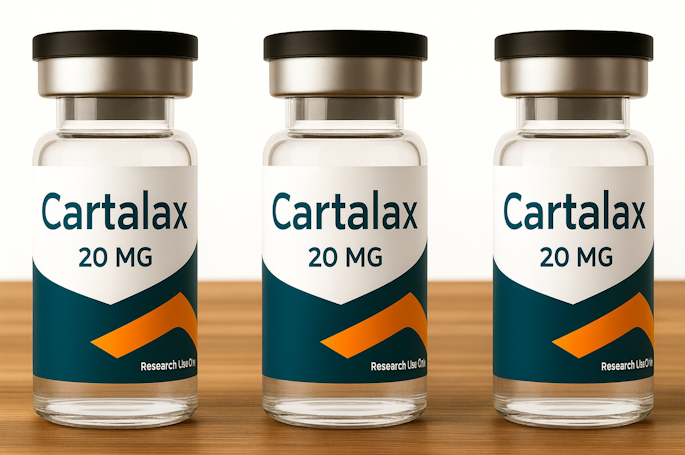
Interested in exploring Cartalax for your lab research? Access high-quality 20mg vials from our recommended partner:

What Is Cartalax Peptide?
- Cartalax Peptide Benefits (research summary)
- Cartalax Peptide Dosage (lab frameworks)
- Cartalax Side Effects (evidence + precautions)
- Cartalax For Sale (reputable places to buy)
Cartalax peptide is commonly described as a peptide bioregulator—one of the tissue-targeted peptides explored in the latest research, Slavic and European literature for their potential to influence gene expression, cell renewal, and the balance of local signaling molecules at the cellular level. As a research chemical, it is examined in vitro testing and animal models for effects related to cartilage health, joint function, and the integrity of connective tissue.
Formulations vary by supplier for laboratory research (for example, lyophilized powder for vitro testing). Regardless of format, any discussion of this peptide here is strictly intended for research use by qualified professionals and not as medical guidance.
Cartalax Peptide Fundamentals: Key Insights for Researchers
Cartalax peptide, a synthetic bioregulator targeting cartilage and connective tissues, is gaining attention in lab studies for its potential role in cellular renewal and tissue-specific support. Researchers often explore its benefits, such as promoting cartilage health in models of degeneration, alongside practical considerations like dosage protocols tailored for men and women in 2026 frameworks.
Key areas include reconstitution guidelines for lab use—ensuring proper mixing with bacteriostatic water to maintain potency—and storage best practices to extend shelf life into 2026. Common beginner pitfalls, such as improper handling leading to degradation, highlight the importance of precise research protocols. When comparing Cartalax to generic peptides, its tissue-specific mechanisms stand out, potentially offering more targeted effects in joint-related experiments.
For those starting out, understanding side effects like mild injection-site reactions and reputable sources for purchasing Cartalax for sale is crucial to avoid contaminants.
For a comprehensive breakdown of Cartalax’s mechanisms and foundational research, see What Is Cartalax Peptide? Mechanisms & Research Breakdown.
Mechanisms Proposed in the Literature
Across studies of peptide bioregulators, authors frequently note two broad themes: modulation of gene expression linked to tissue-specific maintenance and interactions with signaling molecules that may help coordinate local repair in joints and adjacent tissues. For cartalax peptide, exploratory work discusses potential roles in:
- Cell proliferation and the ability to stimulate cell renewal in models using cell cultures of skin and cartilage-related cells.
- Supporting cartilage repair, cartilage regeneration, and maintaining cartilage health through effects on matrix proteins and local peptide regulation.
- Balancing responses associated with inflammation and immune response, which can influence joint discomfort and joint resilience during joint injuries or routine physical activity.
Some authors also discuss how short peptides may contribute to joint lubrication indirectly by supporting matrix components that underpin joint function, joint strength, and long term joint health, as well as reducing inflammation . Compositionally, references sometimes note basic amino acid building blocks—such as glutamic acid and aspartic acid—within broader peptide families, though specific sequences are not the focus of this page.
Potential Role Under Study
Because cartalax peptide is positioned within the tissue-targeted peptides literature, authors frequently evaluate outcomes tied to joint health, joint degeneration, and cartilage maintenance:
- Maintaining joint health: exploratory data look at ways to support joint health, potentially reducing inflammation and reducing pain signals that contribute to joint discomfort and reduced mobility.
- Cartilage health: studies examine matrix and tissue integrity factors relevant to cartilage repair, cartilage regeneration, and prevention of joint degeneration and joint deterioration in aging models.
- Improving mobility: by supporting joints, authors hypothesize downstream effects on enhanced mobility, joint comfort, and day-to-day activities.
For the in-depth evidence roll-up and discussion of study limitations, see our dedicated page: Cartalax Peptide Benefits. That article also summarizes how cartalax peptide appears in contexts like chondrogenic stem cell differentiation, skin fibroblast functions, and matrix peptide regulation that may influence tissues around the joints.
What Researchers Are Saying
Real-world feedback from researchers and users following Cartalax protocols:
Multiple Cycles Completed
After finishing three separate 18-day cycles spaced a few months apart, I can see a pattern. My shoulder and hip mobility has slowly gotten better with each round.
Morning stiffness is not as bad as it used to be. The changes are modest and take time to build. One short cycle alone would probably not have shown much.

Noticed Gradual Joint Improvement
I followed a structured protocol over a few weeks and didn’t expect much at first, but the changes started to add up. Joint stiffness was less noticeable, especially after longer periods of activity. It’s definitely not instant, but consistent use seemed to make a difference.

Starting Low Made a Big Difference
I began at a lower daily amount and increased slowly, which helped avoid any issues early on. The gradual approach made the whole process easier to manage. By the second cycle, I felt more comfortable with the routine and noticed better overall mobility. By the third cycle, I felt reborn. This stuff really works!

Focused on Ankle Recovery
Following a 20-day daily cycle helped support recovery from an old ankle injury. Swelling and discomfort eased slowly over the month after I finished. Flexibility improved more than what physical therapy had achieved on its own.
I intend to repeat the protocol every few months because the joint support seems to add up over time. Taking the full cycle length seriously made a real difference.

Mild Side Effects Noted
I completed a 15-day daily cycle for general knee support. Some reduction in joint discomfort appeared gradually after the cycle ended, but I also felt unusually tired during the second week. The fatigue was mild and passed once I finished. Overall the mobility gains were worth continuing with future cycles after the proper rest period. I will keep a closer eye on energy levels next time.

Looking to get started? Click here to explore high-quality Cartalax sources →
Applications of Cartalax Peptide in Joint Recovery Research
In specialized lab models, Cartalax peptide is investigated for its supportive role in joint recovery, particularly in scenarios involving cartilage repair, arthritis, and injury. Studies focus on conditions like osteoarthritis and knee cartilage degeneration, where Cartalax may influence markers of inflammation and tissue regeneration.
Other applications include back pain and disc degeneration, with user reports and evidence suggesting potential benefits for spinal health. For upper body issues, research explores Cartalax for shoulder and rotator cuff injuries, while in aging models, it targets hip joint health and mobility to combat decline.
Post-injury protocols examine timelines for cartilage repair, tracking observable effects in lab observations. Researchers often query how long Cartalax takes to show effects, with data indicating variable responses based on dosage and administration.
Explore targeted applications in detail with our dedicated guide: Cartalax Peptide For Joint Recovery: Guide To Cartilage Repair, Arthritis & Injury Support.
Advanced Protocols for Optimizing Cartalax Peptide in Labs
For experienced researchers, advanced Cartalax protocols in 2026 emphasize timing, stacking, and optimization to enhance outcomes in joint health models. Micro-dosing strategies offer low-dose approaches for chronic issues, potentially minimizing side effects while sustaining cartilage support.
Timing considerations, such as morning vs. evening dosing, impact joint markers differently based on circadian rhythms. Injection methods compare local targeting for specific joints against systemic delivery for broader effects.
Stacking Cartalax with collagen or hyaluronic acid explores synergies in research, aiming for amplified regeneration. Loading phases, like front-loading for faster cartilage response, accelerate initial effects, while transitioning off protocols focus on maintaining gains post-cycle. For female-specific studies, cycle timing and hormone interactions are key to tailored applications.
Dive into advanced strategies with our optimization pillar: Advanced Cartalax Protocols: Timing, Stacking & Lab Optimization For 2026.
Research Evidence & Citations
To anchor this overview, we link to representative journal discussions about peptide bioregulators, cartilage biology, and aging-related signaling. These are general context sources used to situate cartalax peptide within the wider body of peptides research:
- International Journal of Molecular Sciences (Int J Mol Sci, Mol Sci): reviews on peptide bioregulators, extracellular matrix turnover, and cellular aging—for example, tissue-targeted small peptides and their effects on cell renewal and gene expression.
- Bulletin of Experimental Biology and Medicine (Bull Exp Biol Med): articles on peptide complexes affecting aging cells, connective-tissue tissues, and microenvironmental signaling molecules.
- Molecular Biology Reports (Mol Biol Rep): work on gene expression, matrix remodeling, and chondrocyte biology relevant to cartilage.
These sources do not constitute clinical proof for cartalax peptide; rather, they illustrate the broader scientific dialogue—spanning aging, inflammation, cartilage matrix dynamics, skin and skin fibroblast functions, and peptide-guided modulation of local signaling molecules.
How Cartalax Peptide Might Work (Conceptual)
Across exploratory reports, this peptide is discussed as a synthetic tripeptide–style tissue modulator that could influence cell renewal, cell proliferation, and matrix synthesis. Hypotheses include:
- Matrix & lubrication: by helping preserve the extracellular matrix that supports joint lubrication, authors propose a potential for better joint function and comfort.
- Stem cell context: effects related to chondrogenic stem cell differentiation and behavior of cartilage lineage cells (cartilage health, cartilage repair).
- Stress response & immune response: balancing local responses to tissue damage, inflammation, or repetitive load to promote joint resilience.
Again, these are research-stage ideas about cartalax peptide—useful for forming lab hypotheses around joints, cartilage, and tissues undergoing aging or mechanical stress.
Dosage Concepts for Laboratory Protocols
This site does not provide medical dosing. For lab planning, we compiled common frameworks used in vitro testing and animal study planning, including ranges, cycles, and tracking markers such as cell proliferation indices and gene expression changes. See the full guide: Cartalax Peptide Dosage.
That article also discusses considerations relevant to older adults models and older cells vs. young and old animals, with attention to age related matrix alterations and cellular aging endpoints.
Side Effects, Study Limitations & Precautions
As a research chemical, cartalax peptide lacks established clinical safety profiles. Exploratory reports tend to monitor joint pain, joint discomfort, local irritation, and markers tied to inflammation and stress response. Our safety overview—in a non-clinical sense—summarizes adverse-event tracking methods and open questions: Cartalax Side Effects.
Nothing on this site replaces medical treatment. Work with institutional oversight; this material is strictly intended for research use by qualified professionals.
Practical Context: Joints, Aging & Mobility
Aging tissues experience cumulative load, periodic tissue damage, and changes in the cartilage matrix that can compromise joint function. Exploratory use-cases for cartalax peptide in the literature often center on:
- Improving mobility and comfort in models of mechanical stress where joints face repetitive wear.
- Potential adjuncts to physical therapy paradigms under study, with attention to joint injuries recovery in lab animals.
- Combining lab protocols with a balanced diet, appropriate physical activity, and an active lifestyle in animal-care standards to observe overall health markers.
While early reports note signals suggestive of improve joint health, joint comfort, and enhanced mobility, confirmatory human trials are not available; as such, this peptide remains a topic for laboratory exploration only.
Comparing Cartalax Peptide: Alternatives, Legality, and Research Myths
When evaluating Cartalax against alternatives, comparisons to BPC-157 highlight differences in cartilage repair mechanisms, while vs. glucosamine/chondroitin contrasts peptide potency with traditional supplements.
Legality is a critical factor: Is Cartalax legal in the USA, EU, and under research bans? Status varies, emphasizing the need for compliance in lab settings. Purity guides for 2026 recommend testing labs and spotting vendor red flags to ensure high-quality samples.
Finally, debunking top Cartalax myths—from Reddit anecdotes to studies—clarifies misconceptions, such as exaggerated side effects or unproven claims, grounding research in evidence.
For full comparisons and legal insights, check our summary guide: Cartalax Vs Alternatives: Comparisons, Legality & 2026 Research Summary.
To get started with genuine Cartalax for your studies, visit:

FAQs
What outcomes are commonly tracked with Cartalax peptide?
Investigators frequently monitor cell proliferation, cell renewal markers, matrix proteins (e.g., type XI collagen), chondrocyte behavior, and gene expression patterns related to cartilage homeostasis. Some groups examine skin fibroblast functions, blood vessels microenvironment, or surrogate measures of joint lubrication and joint strength.
Does the literature say anything about aging cells?
Across peptide-bioregulator reviews, authors discuss effects in aging cells, older cells, and young and old animals, often focusing on the interplay between cellular aging, matrix turnover, and peptide-guided peptide regulation of signaling molecules. This is an evolving area in Int J Mol Sci and related journals.
Is Cartalax peptide used clinically?
No. Cartalax peptide is discussed for laboratory research use and is strictly intended for research use. It is not an approved drug. Where appropriate, animal-care committees emphasize welfare, monitoring for joint pain, reducing pain joint discomfort, and ethical endpoints.
Ready to source Cartalax for your research? Our partner offers pure, tested 20mg vials:

Important Research Disclaimer
This site is an educational resource about cartalax peptide for scientists and qualified professionals. Materials are strictly intended for laboratory research use; nothing here is medical advice. Outcomes related to joints, cartilage, health, or overall health are speculative until validated by controlled human studies.